
SHOULDER REPLACEMENT
A total shoulder replacement removes the worn surfaces of an arthritic shoulder and replaces them with artificial components that reproduce the joint's natural shape. It is one of the most reliable operations in orthopaedic surgery for relieving pain, and for the right patient it restores a shoulder that moves and feels close to normal.
It is sometimes called an anatomic total shoulder replacement, to distinguish it from a reverse shoulder replacement, which is built the other way round and used in different circumstances. The anatomic version keeps the natural architecture of the joint — a ball on the arm bone, a socket on the shoulder blade — and for that reason it depends on the rotator cuff tendons being intact and working.
Where those conditions are met, an anatomic replacement generally gives the best movement of any shoulder replacement, particularly the rotation used for reaching behind the back.
What the operation replaces
The shoulder is a ball-and-socket joint. The ball is the head of the humerus, the upper arm bone; the socket, called the glenoid, is a shallow dish on the outer edge of the shoulder blade. Both are lined with articular cartilage, a smooth layer that allows the joint to glide almost without friction.
In shoulder arthritis that cartilage wears away, leaving bone rubbing on bone. The joint becomes painful and stiff, bone spurs form around the rim, and the capsule surrounding the joint tightens.
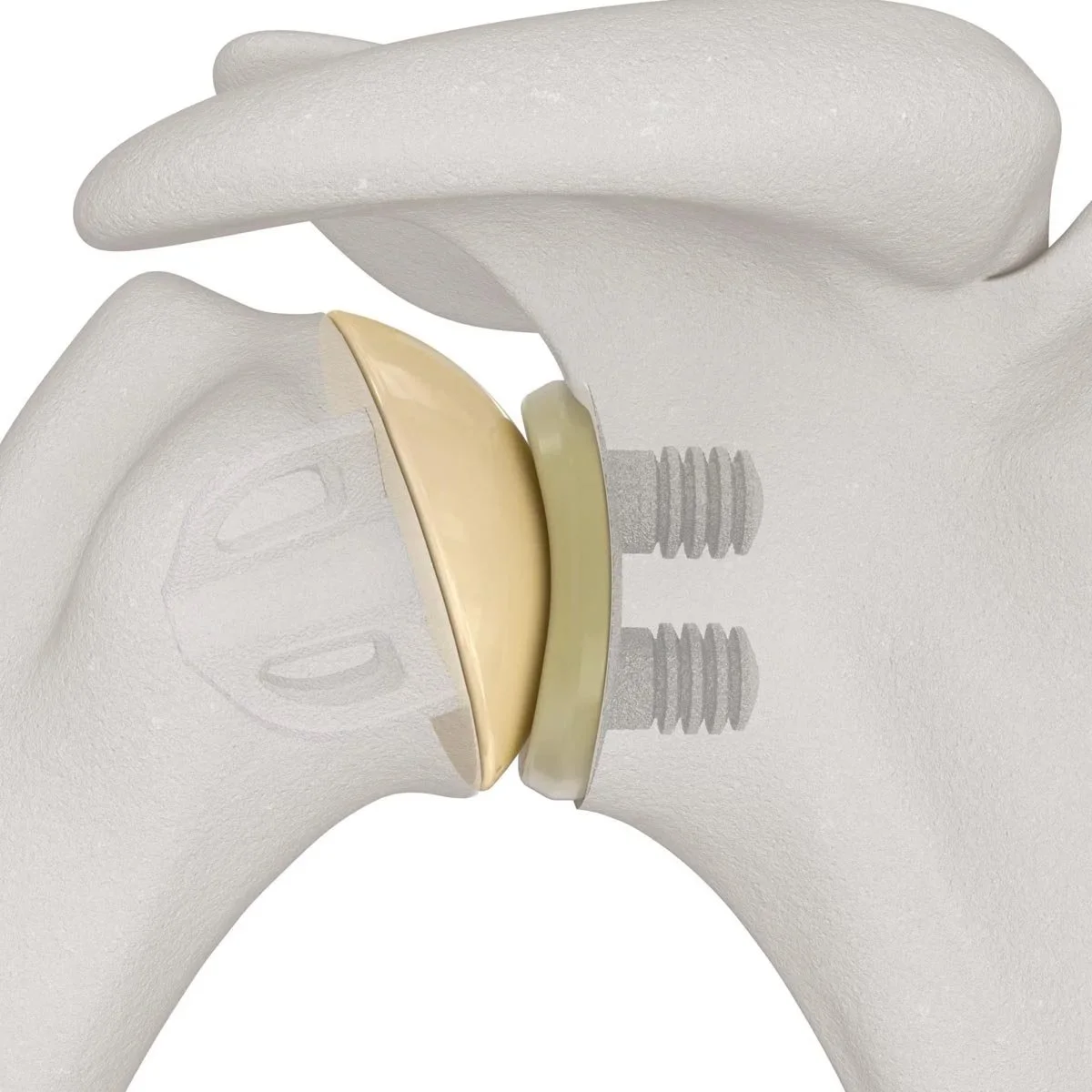
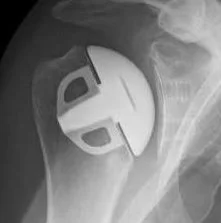
A total shoulder replacement addresses both surfaces. The worn humeral head is removed and replaced with a smooth metal or ceramic ball, supported either by a stem passing down inside the arm bone or, in suitable patients, by a shorter or stemless component that preserves more bone. The worn socket is resurfaced with a smooth polyethylene component.
The result is a joint with new, smooth bearing surfaces in the natural configuration — which is why the shoulder tends to feel familiar to patients afterwards rather than mechanically different.
Who a total shoulder replacement suits
The operation is considered when three things are true together: arthritis is causing pain and stiffness that significantly limit daily life or sleep, non-operative treatment has been tried without adequate benefit, and the patient themselves wants an operation.
Beyond that, an anatomic replacement specifically requires:
An intact, functioning rotator cuff. This is the central requirement. The implant relies on those tendons to keep the ball centred in the socket and to power movement. If the cuff is torn or substantially degenerate, an anatomic replacement will not work well and will tend to fail over time — a reverse replacement is the better choice.
Adequate bone in the socket. The glenoid component needs enough good-quality bone to be securely fixed. Where the socket is severely worn, eroded or deformed, secure fixation may not be achievable and a reverse is more dependable.
Reasonable general health, sufficient to undergo an anaesthetic and to participate in rehabilitation.
The conditions most commonly treated this way are osteoarthritis of the shoulder, post-traumatic arthritis following an old fracture or repeated dislocations, and avascular necrosis, where the blood supply to the humeral head has been lost.
Age is not in itself a barrier. Younger patients are certainly candidates, but it is worth knowing that implants have a finite life and a replacement performed at 50 is more likely to need revision during a lifetime than one performed at 70. That is a factor to weigh rather than a reason to refuse, and it is one reason non-operative treatment is usually pursued thoroughly first.
Anatomic or reverse — how the choice is made
Both operations relieve pain reliably. The differences are in what they require and what they deliver. Total shoulder replacement requires a functioning rotator cuff with no significant damage. If there is damage then a reverse shoulder replacement is a better option.
In New Zealand, reverse replacement now accounts for around three-quarters of shoulder replacements performed. That reflects the range of problems it can address rather than any deficiency in the anatomic operation: where a patient meets the criteria above, an anatomic replacement remains the operation that restores the most natural shoulder.
The operation
Total shoulder replacement is performed under general anaesthetic, almost always combined with a nerve block that numbs the arm and provides substantial pain relief for the first 2 to 3 days. Antibiotics are given to reduce the risk of infection.
The operation usually takes between one and two hours. An incision is made at the front of the shoulder and the joint approached between the muscle planes. To reach the joint, the subscapularis — the rotator cuff tendon at the front of the shoulder — is carefully detached and repaired securely at the end of the procedure. This repair is the single most important reason for the restrictions in the first six weeks after surgery: the tendon needs time to heal, and using the arm too actively too early risks disrupting it.
Most patients stay one night in hospital after surgery. Pain is managed with a combination of the nerve block, regular pain relief and, initially, stronger medication as required. Discomfort is usually most noticeable when the nerve block wears off, and settles substantially over the following few days.
A sling is worn for around six weeks. This period is dictated by the healing of the subscapularis repair. Gentle assisted and passive movements begin early — the arm is moved by the other hand, by a physiotherapist, or by gravity, rather than by the shoulder's own muscles. Active lifting of the arm, and in particular reaching behind the back or rotating the arm outwards beyond a set limit, are avoided during this period. Pushing up out of a chair with the operated arm is also avoided, as it loads the repair directly.
Most of the early pain settles within two to three weeks. Sleeping is often the hardest part — most patients are more comfortable propped upright in a recliner or on pillows for the first fortnight. Driving is not permitted while the sling is in use.
Movement and strength continue to improve gradually. The final result is usually apparent at around twelve months, and some patients continue to notice small gains beyond that.
Physiotherapy is an essential part of the process rather than an optional extra, and the eventual result depends significantly on the work done during rehabilitation.
What to expect afterwards
Pain relief is the most reliable outcome. The great majority of patients experience substantial and lasting relief, and this is usually the change patients value most. Satisfaction after total shoulder replacement is consistently high.
Movement is usually good. Most patients can lift the arm to above shoulder height and reach the top of the head or into a cupboard. Where an anatomic replacement has an advantage over a reverse, it is in rotation — reaching behind the back to fasten clothing or retrieve a wallet is often restored well.
The shoulder tends to feel natural. Because the joint keeps its normal configuration, most patients describe the shoulder as feeling like their own rather than like a mechanical joint.
Strength is improved but not unlimited. The shoulder will handle everyday loads comfortably. It is not built for heavy lifting.
The starting point matters. A shoulder that was very stiff before surgery generally ends up with less movement than one that was mainly painful, which is one reason for keeping movement going during the non-operative phase.
Activities and restrictions
A total shoulder replacement suits golf, swimming, cycling, bowls, walking and tramping, gardening, light gym work and ordinary daily activity. Many patients return to a better standard of golf or swimming than they had managed for years beforehand.
It is not suited to heavy overhead lifting, contact or collision sport, or repeated impact loading such as hammering or using heavy vibrating tools. These accelerate wear of the polyethylene socket and increase the risk of loosening.
Results and how long it lasts
New Zealand has a national joint registry that has recorded every joint replacement performed in the country since 1999, which gives unusually reliable long-term data.
For anatomic total shoulder replacement, around 92% are still in place at ten years. Revision rates are higher in younger, more active patients — a pattern common to joint replacement generally.
Anatomic replacements have a slightly higher revision rate than reverse replacements in the registry data. There are two straightforward reasons, and neither means the operation is less good. Anatomic replacements are performed in a younger, more active group of patients on average. And they depend on a rotator cuff that can itself wear or tear in the years afterwards — where that happens, the usual solution is conversion to a reverse replacement, which is counted as a revision. That conversion is a well-established procedure with a reliable result.
Risks and complications
Total shoulder replacement is a safe and well-established operation, and serious complications are uncommon.
Infection occurs in approximately 1% of cases. Superficial infection may settle with antibiotics; deep infection around the implant is uncommon but usually requires further surgery.
Subscapularis failure. The repaired tendon at the front of the shoulder can fail to heal or re-tear, causing weakness and a feeling of instability. This is the reason for the care taken in the first six weeks. It occasionally requires further surgery.
Glenoid loosening. Loosening of the socket component is the most common long-term reason for revision of an anatomic replacement. It develops gradually over years and is monitored on follow-up X-rays.
Rotator cuff failure over time. The cuff can tear in the years after surgery, which alters how the replacement functions and may lead to conversion to a reverse replacement.
Instability or dislocation occurs in approximately 1% of cases.
Nerve injury, usually temporary, can cause numbness, tingling or weakness in the arm or hand. Most recovers over weeks to months. Permanent nerve injury is rare.
Stiffness, which may limit the final range of movement, particularly where the shoulder was very stiff beforehand.
Fracture of the bone around the implant, either during surgery or as a result of a later fall.
Blood clots in the leg or lung, and the general risks associated with anaesthesia and major surgery.