SHOULDER INSTABILITY
The shoulder joint is a shallow ball and socket joint which allows for great movement but comes at a cost. The shoulder joint is held together by the joint capsule, ligaments, the rim of cartilage on the socket (labrum) and rotator cuff muscles. When those restraints are damaged or simply too loose, the ball can slide partly out of the socket — a subluxation — or come all the way out, which is a dislocation.
Shoulder instability is the term for a shoulder that does this repeatedly, or that feels as though it might. It is common in rugby, netball, cricket, and rugby league, but it also affects people who have never had a significant injury at all. After the first episode, it is likely that the labrum and ligaments will be damaged, putting the shoulder at high risk of recurrent episodes of instability. This is especially true for patients under the age of 25 years.
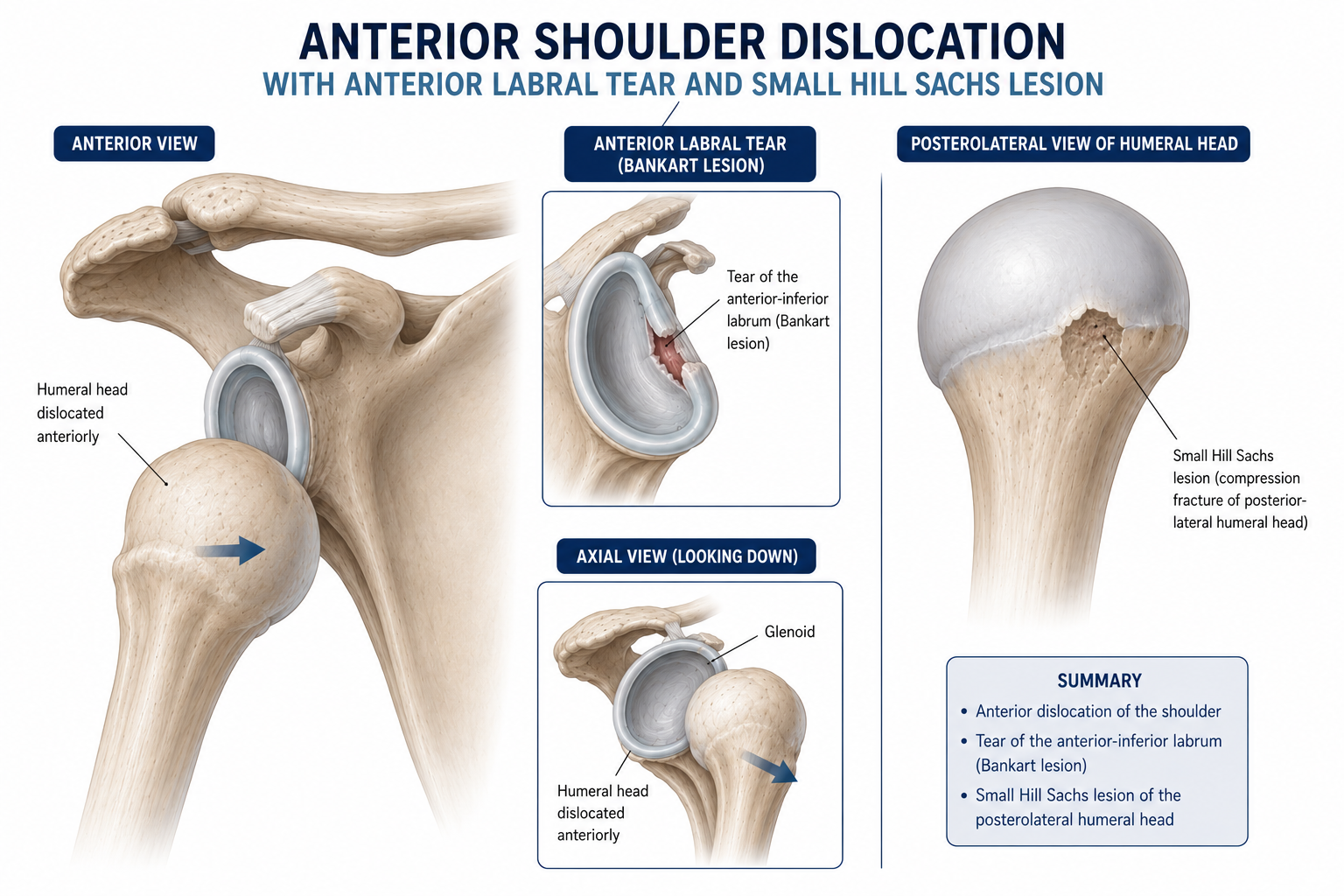
Two points are important in shoulder instability. First, not every recurrent shoulder stays unstable: second, repeated dislocation is not harmless — roughly two-thirds of shoulders showed some degree of arthritis 25 years after a first dislocation, and each further dislocation risks additional damage to the socket rim.
The practical message is that a young person who dislocates a shoulder playing sport is very likely to do it again, and that this is worth discussing early rather than after the third or fourth episode.
Non-surgical treatment
Immobilisation. A sling for comfort in the early days is helpful. The evidence does not support long periods in a sling — studies have found the duration of immobilisation makes no difference to the risk of further dislocation.
Physiotherapy is the mainstay. A structured programme rebuilds rotator cuff and shoulder blade control, restores range gradually, and retrains the movement patterns that put the shoulder at risk. For atraumatic and multidirectional instability, rehabilitation is the primary treatment, not a preliminary to surgery.
Activity modification — adjusting gym technique, avoiding provocative positions during the rehabilitation phase, and staging a return to contact sport — is part of the plan for every patient.
When surgery is considered
Surgery is discussed when the shoulder keeps dislocating or subluxing despite rehabilitation, when instability limits work or sport, when there is significant bone loss from the socket, or when a torn labrum is unlikely to heal on its own in a young patient returning to collision sport.
Early stabilisation after a first dislocation is worth considering in high-risk patients — young, male, playing contact or overhead sport. This group is at high risk of further dislocation without surgery.
Arthroscopic Bankart repair
The most common operation for traumatic anterior instability. Through several small incisions, a camera is placed in the joint, the torn labrum is freed and repositioned on the rim of the socket, and it is held there with small anchors and sutures while it heals. The capsule is tightened at the same time. It is keyhole surgery, usually done as a day case. It works best in shoulders with an intact bony socket. As bone loss from the socket rim increases, the failure rate of a soft-tissue repair rises.
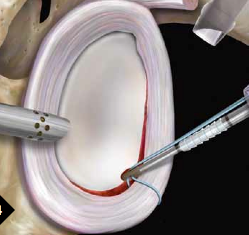
Labral Tear (Bankart lesion)
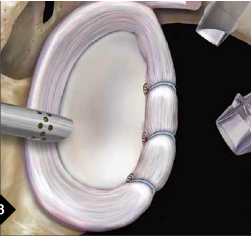
Bankart Repair
Bankart repair with remplissage
Where the dent in the back of the ball (the Hill-Sachs lesion) is large enough to catch on the rim, a remplissage can be added. Part of the rotator cuff tendon and capsule is stitched into the dent, filling it so that it no longer engages with the socket.
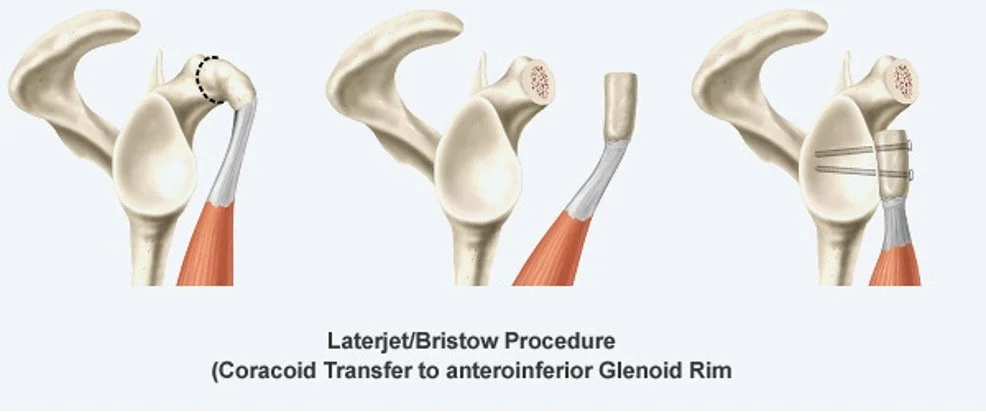
Latarjet procedure
For shoulders with significant bone loss from the socket, a repeat dislocation after previous surgery, or high-risk collision athletes, the Latarjet is the more reliable option. A small piece of bone from the front of the shoulder blade — the coracoid — is transferred with its attached tendon onto the front of the socket. This does three things: it rebuilds the missing bone, the transferred tendon acts as a sling supporting the joint from below, and the repair reinforces the front of the capsule.
It is a bigger operation than a keyhole repair, and the complication rate is correspondingly higher .