
MENISCAL INJURIES
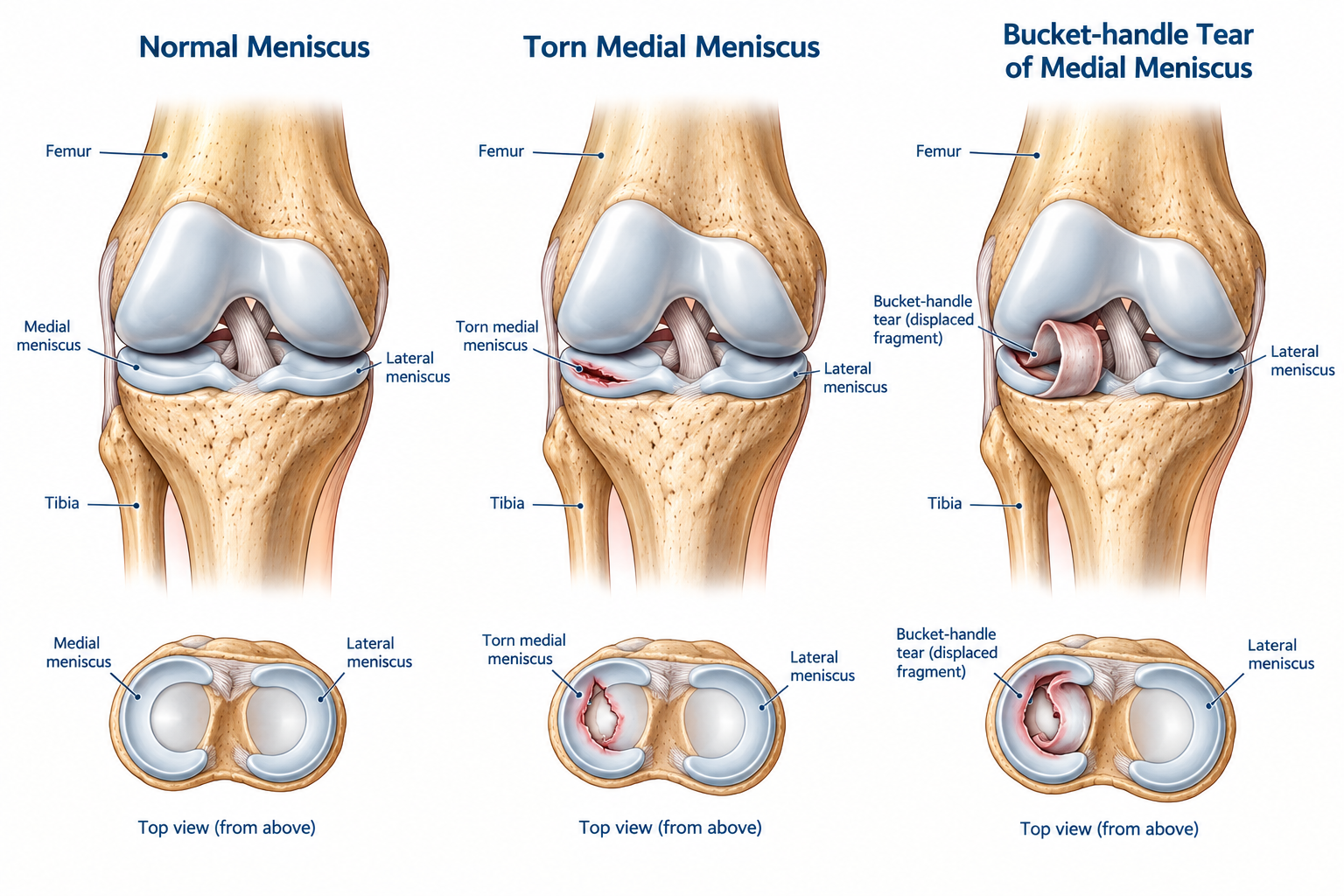
The menisci are two crescent-shaped pads of cartilage that sit between the thigh bone and the shin bone, one on the inner side of the knee and one on the outer. They spread load across the joint and help keep it stable, and a torn meniscus is one of the most common knee injuries seen.
The term covers two quite different situations, and it is worth separating them at the outset, because the right treatment for one is close to the opposite of the right treatment for the other.
A traumatic tear happens to an otherwise healthy meniscus during a specific twisting injury, usually in a younger person. There is a clear event. These tears sometimes need surgery, and where surgery is indicated, repairing the meniscus is often possible.
A degenerative tear develops gradually in a meniscus that has been wearing out over years, usually in someone over 50. There is often no injury at all, or a trivial one. These tears are part of the same process as knee arthritis, and the evidence is clear that keyhole surgery does not necessarily help them.
Which of the two is present determines almost everything that follows.
What the menisci do
Each meniscus is a wedge-shaped ring of tough fibrocartilage, thicker at its outer edge and tapering inwards, anchored to the shin bone at the front and back by attachments called roots.
Their main job is to spread load. Without them, the rounded end of the thigh bone would contact the relatively flat top of the shin bone over a very small area. The menisci deepen the surface and distribute that force across the joint — they carry well over half the load passing through each side of the knee. They also contribute to stability, help distribute joint fluid across the cartilage, and assist with shock absorption.
This is why preserving meniscal tissue matters. Removing a portion of a meniscus concentrates load onto a smaller area of articular cartilage, and over years that accelerates wear. The more meniscus removed, the greater the effect. Surgical thinking has shifted substantially over the past two decades as a result: where surgery is needed, the aim now is to preserve and repair wherever it is feasible, and to remove as little as possible where it is not.
Blood supply is the limiting factor in healing. Only the outer portion of each meniscus — roughly the outer quarter to a third — has a blood supply. Tears in that zone can heal if repaired. Tears in the inner portion have no blood supply and will not heal, whatever is done to them.
The two kinds of tear
Traumatic tear Degenerative tear
Typical age Under 40 Over 50
Cause A specific twisting injury Gradual wear; often no injury, or a trivial one
Onset Sudden, often with a pop / click Gradual ache over weeks or months
The meniscus is Otherwise healthy Already degenerate
Associated arthritis Usually none Usually present to some degree
Locking Can occur, sometimes true locking Catching common, true locking rare
First-line treatment Depends on the tear; repair often possible Exercise and non-operative care
Arthroscopy Appropriate for selected tears Not recommended as first-line
ACC Generally covered Often not — see below
Symptoms
Pain is usually felt along the joint line, on the inner or outer side of the knee, and is worse with twisting, squatting, deep bending and getting in and out of a car.
Swelling develops over a day or so after a traumatic tear — more slowly than the rapid swelling that suggests an ACL injury — and comes and goes with activity in degenerative tears.
Clicking or catching is common, as a torn flap moves within the joint.
Giving way may occur, though this is more often due to pain inhibiting the quadriceps than to true instability.
True locking is the symptom that changes management. This means the knee physically will not straighten — a torn fragment is caught between the bones, blocking movement, and the knee is stuck in a bent position. It is not the same as a knee that is stiff, sore or reluctant to straighten. True locking is uncommon, and it is one of the few clear indications for prompt surgery.
Diagnosis
Assessment begins with the history — was there an injury, and what happened — and examination of the joint line, the range of movement, and specific tests that load and rotate the meniscus.
X-rays, taken standing, are important, particularly in patients over 40. They do not show the meniscus, but they show how much arthritis is present, and that is often the single most useful piece of information in deciding what to do. A patient over 50 with joint space narrowing on a standing X-ray is being assessed for arthritis with a degenerate meniscus, not for an isolated meniscal problem.
MRI shows the meniscus in detail and confirms the tear pattern and location. It is most useful in younger patients with a clear injury, where the type of tear determines whether repair is possible.
It comes with an important caveat, worth stating plainly because it changes how patients interpret their scan. Meniscal tears are found on MRI in a large proportion of people who have no knee symptoms at all — in the order of one in three adults over 50, and more than half of those over 70. Finding a tear on a scan therefore does not establish that it is the cause of the pain. In an older knee, the tear is often an incidental feature of a joint that is wearing out, and treating the tear does not treat the problem.
Traumatic tears
Non-operative treatment
Not every traumatic tear needs surgery. Small, stable tears — particularly those in the outer, well-supplied portion — can settle with time and rehabilitation, and some heal. A period of activity modification, physiotherapy and quadriceps strengthening is reasonable for a tear that is not locking the knee and not causing significant mechanical symptoms.
Where symptoms settle and the knee functions well, no further treatment is needed.
Repair
Where surgery is indicated and the tear is in the outer, vascular zone, repair is preferred. The tear is stitched together arthroscopically using sutures or small implants, and the meniscus heals over the following months, preserving its load-spreading function and protecting the joint over the long term.
Repair is favoured by tears that are recent, in the outer zone, in younger patients, and — notably — in knees also undergoing ACL reconstruction, where healing rates are better. It is not possible for every tear: the pattern and location have to be suitable, and a degenerate meniscus does not hold sutures or heal reliably.
Repair asks more of the patient than trimming does. Recovery is longer, with a period of restricted weight-bearing and limited bending while the repair heals, and return to sport takes months rather than weeks. Repairs also fail in a proportion of cases — published follow-up beyond five years suggests roughly one in five eventually requires further surgery, with failures often occurring after the second year. Even allowing for that, preserving the meniscus is generally worth the longer recovery and the risk of needing another operation, because the alternative permanently removes tissue the knee cannot replace.
Partial meniscectomy
Where a tear cannot be repaired — an inner-zone tear with no blood supply, or a pattern unsuitable for suturing — the torn portion is trimmed back to a stable rim, removing as little as possible.
This gives reliable relief of the mechanical symptoms and a fast recovery, but it does not restore the meniscus, and removing tissue increases load on the articular cartilage. That trade-off is accepted when there is no better option, and it is a reason to preserve rather than remove wherever the choice exists.
Root tears
A root tear detaches the meniscus from its anchor point on the shin bone. Because the meniscus works by resisting the outward force generated as it is compressed, losing the root effectively disables the whole meniscus even though it looks largely intact — the biomechanical equivalent of removing it entirely.
Root tears are increasingly recognised and are associated with rapid deterioration of the joint if left. In suitable patients, repairing the root is worthwhile.
Tears with an ACL injury
Meniscal tears frequently accompany ACL ruptures, and where both are present they are addressed at the same operation. Meniscal repairs performed alongside ACL reconstruction have better healing rates than repairs done in isolation.
Degenerative tears
This is where the evidence has changed most.
A degenerate meniscus tears gradually, often without any injury the patient can identify. On a scan it looks torn; clinically it is one feature of a knee in the early stages of arthritis. The pain usually comes from the joint as a whole rather than from the tear.
Multiple high-quality randomised trials have now shown that arthroscopic trimming of a degenerative meniscal tear provides minimal meaningful benefit over exercise therapy or non-operative treatment. Keyhole surgery should not be offered as first-line treatment for a degenerative meniscal tear, and non-operative treatment should be tried for at least three months first.
That non-operative treatment is not passive waiting. It is the same programme that works for knee arthritis— quadriceps and hip strengthening, low-impact aerobic exercise, activity modification, appropriate pain relief and, where useful, an injection to allow rehabilitation to proceed. Trials comparing that programme against arthroscopy consistently find the two produce similar results, which means the operation is being avoided rather than the treatment.
When surgery is still appropriate
There are genuine exceptions, and it would be wrong to imply otherwise.
True locking — a knee physically blocked from straightening by a displaced fragment — warrants prompt arthroscopy regardless of age.
Persistent significant mechanical symptoms — genuine catching or locking episodes, not simply pain — that have not settled after an adequate trial of at least three months of non-operative treatment, in a knee without advanced arthritis on standing X-rays, may reasonably be considered for arthroscopy.
A displaced bucket-handle tear in an otherwise reasonable knee is a mechanical problem requiring mechanical treatment.
What does not warrant arthroscopy is pain alone in a knee with established arthritis and a degenerate tear on MRI, however convincing the scan report reads. In that situation, an operation carries the risks of surgery without the benefit, and the patient is better served by treating the arthritis.
The operation and recovery
Meniscal surgery is performed arthroscopically, through two or three small incisions with a camera inside the joint, under general anaesthetic and usually as day surgery. The procedure typically takes under an hour.
Recovery differs substantially between trimming and repair, and it is worth knowing which is planned — although in some cases the decision can only be finalised once the tear is seen directly, so both possibilities are discussed beforehand.
Partial meniscectomy (trim) Meniscal repair
Weight-bearing Immediately, as comfortable Often restricted for several weeks
Brace Not usually Often, with limited bending
Crutches Not required Usually several weeks
Desk work Around 1 week 1–2 weeks
Driving 1–2 weeks 4–6 weeks
Physical work 3–6 weeks 3 months or more
Return to sport 4–8 weeks 4–6 months
Physiotherapy is part of both pathways. After a trim it is largely about restoring strength and movement quickly; after a repair it is about protecting the healing tissue while gradually restoring function, and it is more prolonged.
Risks and complications
Knee arthroscopy is a safe, commonly performed operation and serious complications are uncommon.
Infection is uncommon, occurring in well under 1% of arthroscopic procedures.
Blood clots in the leg or lung, which are uncommon but recognised.
Persisting pain, particularly where the tear was not the main source of symptoms — one of the reasons for careful patient selection.
Stiffness, more common after repair than after trimming.
Failure of a repair, requiring further surgery, in a proportion of cases.
Nerve injury, usually a small patch of numbness near an incision, which is common and rarely troublesome; significant nerve injury is rare.
Progression of arthritis over the longer term, particularly where a substantial portion of meniscus has been removed.
ACC and costs
The position depends on which kind of tear it is, and this is worth understanding before an appointment.
A traumatic tear — a specific twisting injury in an otherwise healthy knee — is an accident, and treatment is generally covered by ACC, including assessment, imaging, surgery and physiotherapy.
A degenerative tear is wear rather than injury, and ACC cover is often declined on that basis, even where a minor incident preceded the symptoms. Where an injury has aggravated pre-existing wear, the position can be less clear-cut, and claims are assessed individually.