
REVERSE SHOULDER REPLACEMENT
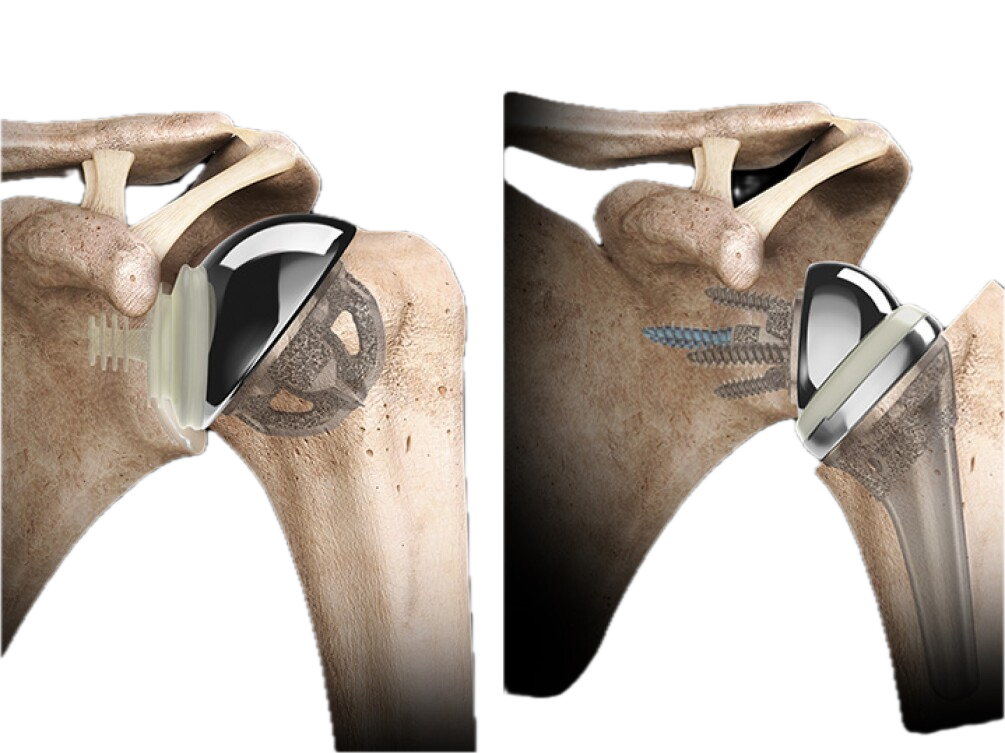
A reverse shoulder replacement is an artificial shoulder joint built the other way round from the natural one. Rather than a ball on the arm bone sitting in a socket on the shoulder blade, the ball is fixed to the shoulder blade and the socket to the top of the arm bone.
That change sounds strange, but there is a clear reason for it. It allows a shoulder to work using the large deltoid muscle over the top of the shoulder, rather than depending on the rotator cuff tendons — which is what makes it possible to restore a working shoulder to someone whose rotator cuff is worn out or torn beyond repair.
It has become the most common form of shoulder replacement performed in New Zealand, now accounting for around three-quarters of all shoulder replacements. It is a reliable operation, particularly for relieving pain and for restoring the ability to lift the arm.
Why "reverse"?
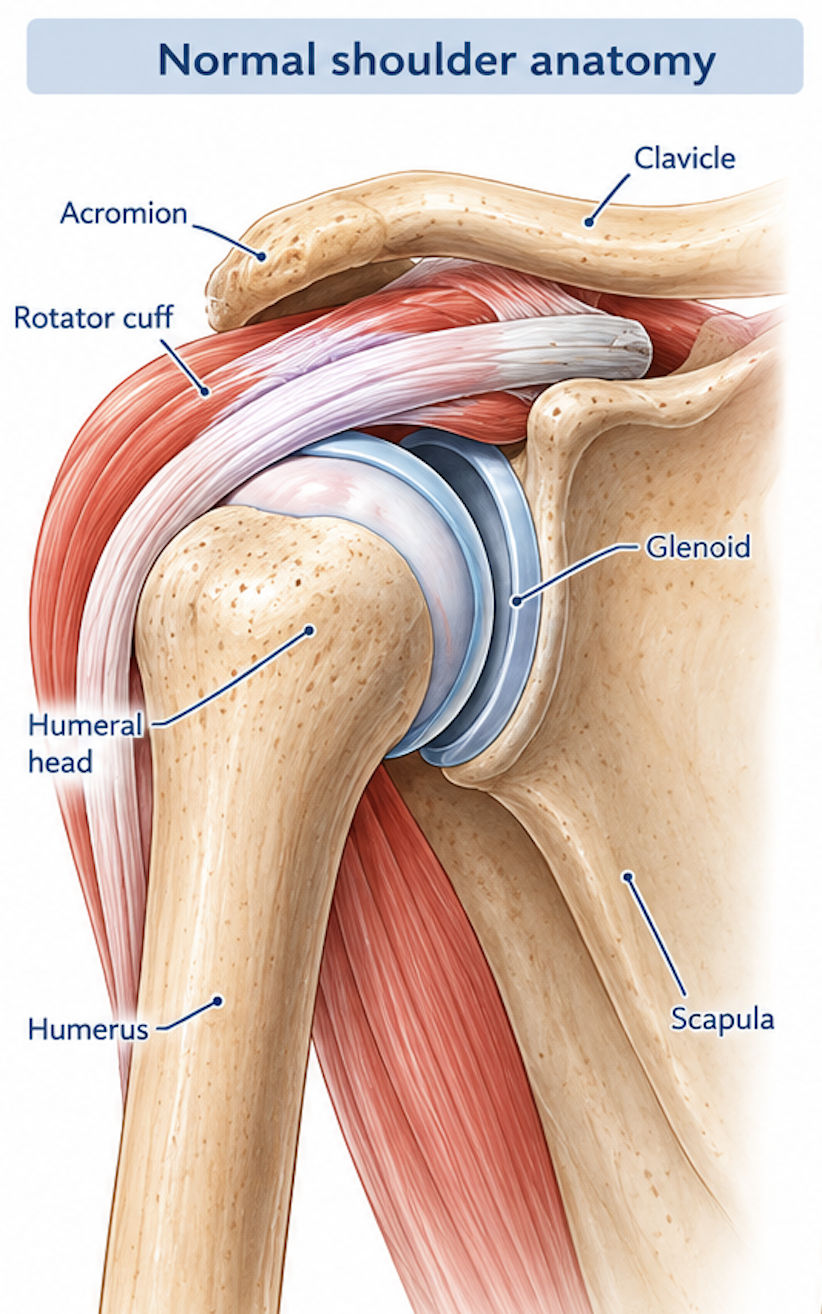
In a normal shoulder, the rotator cuff — four muscles and tendons wrapping the joint — holds the ball of the arm bone centred in its shallow socket. Without that, when the powerful deltoid muscle contracts to lift the arm, the ball simply slides upwards instead of rotating in place, and the arm does not rise. This is why some people with large rotator cuff tears cannot lift their arm at all, even though the muscle that should do the lifting is perfectly strong.
Reversing the joint solves this mechanically. Placing the ball on the shoulder blade and the socket on the arm bone shifts the centre of rotation inwards and downwards. This does two things: it gives the deltoid better leverage, and it creates a stable, constrained joint that cannot slide upwards. The deltoid can then lift the arm on its own, with no contribution from the rotator cuff required.
Who a reverse replacement is for
Reverse replacement was originally developed for one specific problem and has since been found useful in several others.
Rotator cuff tear arthropathy. The classic indication — arthritis of the shoulder joint combined with a large, irreparable rotator cuff tear. The joint is both painful and unable to lift, and no other operation addresses both problems.
Massive irreparable rotator cuff tear without arthritis. Some patients have an intact-looking joint but a tear too large to repair, leaving them unable to raise the arm — sometimes called a pseudoparalytic shoulder. A reverse replacement can restore that movement.
Osteoarthritis with a significantly worn or deformed socket. Where the glenoid has worn asymmetrically or lost bone, an anatomic replacement may not be securely supportable, and a reverse is the more durable choice.
Osteoarthritis in older patients with uncertain rotator cuff quality. An anatomic replacement depends on the cuff continuing to work for the life of the implant. Where the cuff is already thin or partially torn, a reverse avoids the risk of the replacement failing later for that reason.
Fractures of the upper humerus. In older patients with a badly broken shoulder that cannot be reliably fixed, a reverse replacement gives a more predictable result than the alternatives.
Revision of a previous shoulder replacement. Where an earlier replacement has failed — commonly because the rotator cuff has subsequently torn — a reverse is often the salvage option.
Inflammatory arthritis, such as rheumatoid arthritis, where both the joint surfaces and the rotator cuff are frequently affected.
Reverse or anatomic — how the choice is made
Both operations relieve pain reliably. The differences are in what they require and what they deliver. Anatomic shoulder replacement requires the rotator cuff to be functioning well to perform at its best. If there is damage to the rotator cuff, reverse shoulder replacement works better.
The operation
Reverse shoulder replacement is performed under general anaesthetic, almost always combined with a nerve block that numbs the arm and provides substantial pain relief for the first few days.
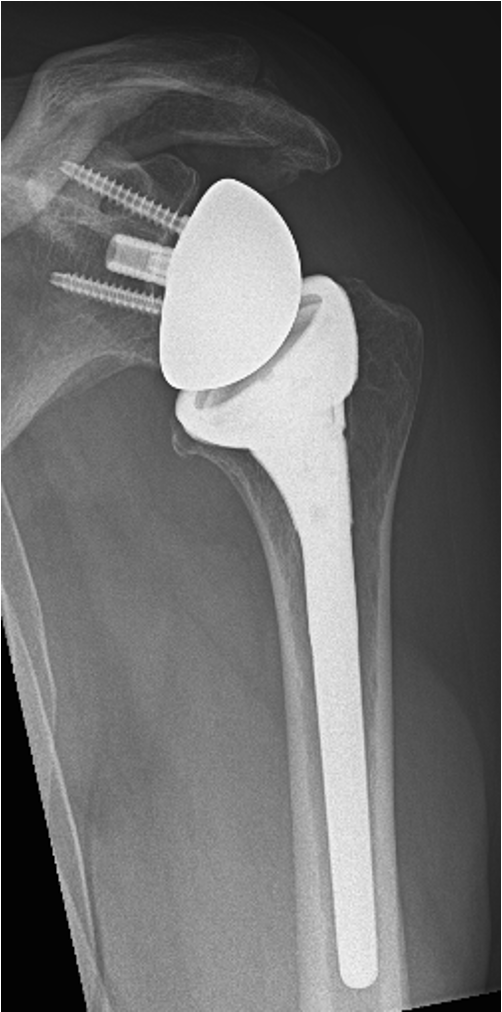
The operation usually takes between one and two hours. An incision is made at the front of the shoulder, and the joint is exposed between the muscle planes. The worn head of the humerus is removed and the bone prepared to accept the stem carrying the new socket. On the shoulder blade, the worn socket is prepared and a metal baseplate is fixed to it with screws, and the ball — the glenosphere — is attached to that baseplate. The components are then brought together and the tension of the surrounding tissues checked carefully, as this is what determines both stability and how well the deltoid will work.
Recovery
Most patients stay one night in hospital. Pain is managed with a combination of the nerve block, regular pain relief and, initially, stronger medication as required. Pain usually settles in the first two to three weeks. A sling is worn for the first week. It protects the shoulder while the soft tissues heal. It can generally be removed for exercises, washing and dressing.
Sleeping is often the hardest part of the first few weeks. Most patients are more comfortable propped upright in a recliner or on pillows for the first fortnight.
Movement and strength continue to improve gradually. The final result is usually apparent at around twelve months, and some patients continue to notice small gains beyond that.
Physiotherapy is an essential part of the process rather than an optional extra. The eventual result depends significantly on the work done during rehabilitation.
What to expect afterwards
Being clear about realistic expectations matters more with a reverse replacement than with most operations, because what it does well and what it does less well are quite distinct.
Pain relief is the most reliable outcome. The great majority of patients experience substantial and lasting relief, and this is usually the change patients value most.
Lifting the arm is generally restored. Most patients regain the ability to raise the arm to around shoulder height or a little above — enough for reaching a shelf, washing hair, hanging out laundry and most household tasks. Some achieve considerably more.
Rotation is the common limitation. Reaching behind the back — fastening a bra, retrieving a wallet from a back pocket, tucking in a shirt — often remains difficult, and in some cases does not improve. This is the trade-off inherent in the design, and it is worth thinking about before surgery, particularly for patients for whom that specific movement matters.
Strength is improved but not normal. The shoulder will handle everyday loads well. It is not built for heavy lifting.
Activities and restrictions
A reverse replacement suits golf, swimming, cycling, bowls, walking and tramping, gardening, light gym work and ordinary daily activity.
It is not suited to heavy overhead lifting, contact or collision sport, or repeated impact loading such as hammering or using heavy vibrating tools. These accelerate wear and increase the risk of loosening or of a stress fracture in the shoulder blade. A commonly used guideline is to avoid lifting more than around 5 to 10 kilograms with the operated arm on an ongoing basis, and to avoid sudden heavy pulls or catching a falling object with that arm.
Results and how long it lasts
New Zealand has a national joint registry that has recorded every joint replacement performed in the country since 1999, which gives reliable long-term data.
Reverse shoulder replacement performs well in this data. It has the lowest revision rate of any type of shoulder replacement recorded in the registry, with around 96% still in place at ten years. Revision rates are lowest in older patients and higher in younger, more active ones — a pattern common to joint replacement generally, and a genuine consideration when weighing up timing in a younger patient.
Patient satisfaction after reverse replacement is high, driven mainly by pain relief and by the return of the ability to use the arm at shoulder height.
Risks and complications
Reverse shoulder replacement is a safe and well-established operation, and serious complications are uncommon. They are worth understanding before deciding, and Mr Coleman will discuss them in the context of each patient's own health and anatomy.
Infection occurs in approximately 1% of cases. Superficial infection may settle with antibiotics; deep infection around the implant is uncommon but usually requires further surgery.
Dislocation of the replacement occurs in approximately 1% of cases. It is more relevant to reverse than anatomic replacements and usually happens early. It may be managed by relocating the joint under anaesthetic, or may require revision surgery.
Nerve injury, usually temporary, can cause numbness, tingling or weakness in the arm or hand. Most recovers over weeks to months. Permanent nerve injury is rare.
Stress fracture of the acromion or scapular spine — the bone at the top of the shoulder blade — is a complication relatively specific to reverse replacement, caused by the increased tension the reconfigured joint places on that bone. It is uncommon, typically presents as new pain some weeks or months after an initially good recovery, and is usually managed without further surgery, though it can limit the final result.
Scapular notching describes wear of the bone on the lower edge of the socket where the implant contacts it. It is visible on X-rays in a proportion of patients and is often of no consequence, but is monitored as it can contribute to loosening over time.
Loosening or wear of the components is the usual reason for revision surgery in the longer term.
Fracture of the bone around the implant, either during surgery or as a result of a later fall.
Blood clots in the leg or lung, and the general risks associated with anaesthesia and major surgery.