
FROZEN SHOULDER
The shoulder joint is a shallow ball and socket joint which allows for great movement but comes at the risk of shoulder instability. The joint capsule, ligaments and rotator cuff muscles are crucial in maintaining the stability but need to be elastic and flexible to allow movement to occur.
Frozen shoulder, also called adhesive capsulitis, is a condition where the capsule surrounding the shoulder joint becomes inflamed and tight. This causes pain and progressive stiffness, often making everyday activities such as dressing, reaching overhead or putting on a jacket difficult. Frozen shoulder usually develops gradually and can occur without an obvious cause. It can also occur after an injury, surgery or a period of reduced shoulder movement.
The exact underlying cause of frozen shoulder is unknown but the capsule of the shoulder joint becomes inflamed. Some groups of people are more at risk of frozen shoulder such as people with diabetes, thyroid disease, heart disease and Parkinson’s disease.
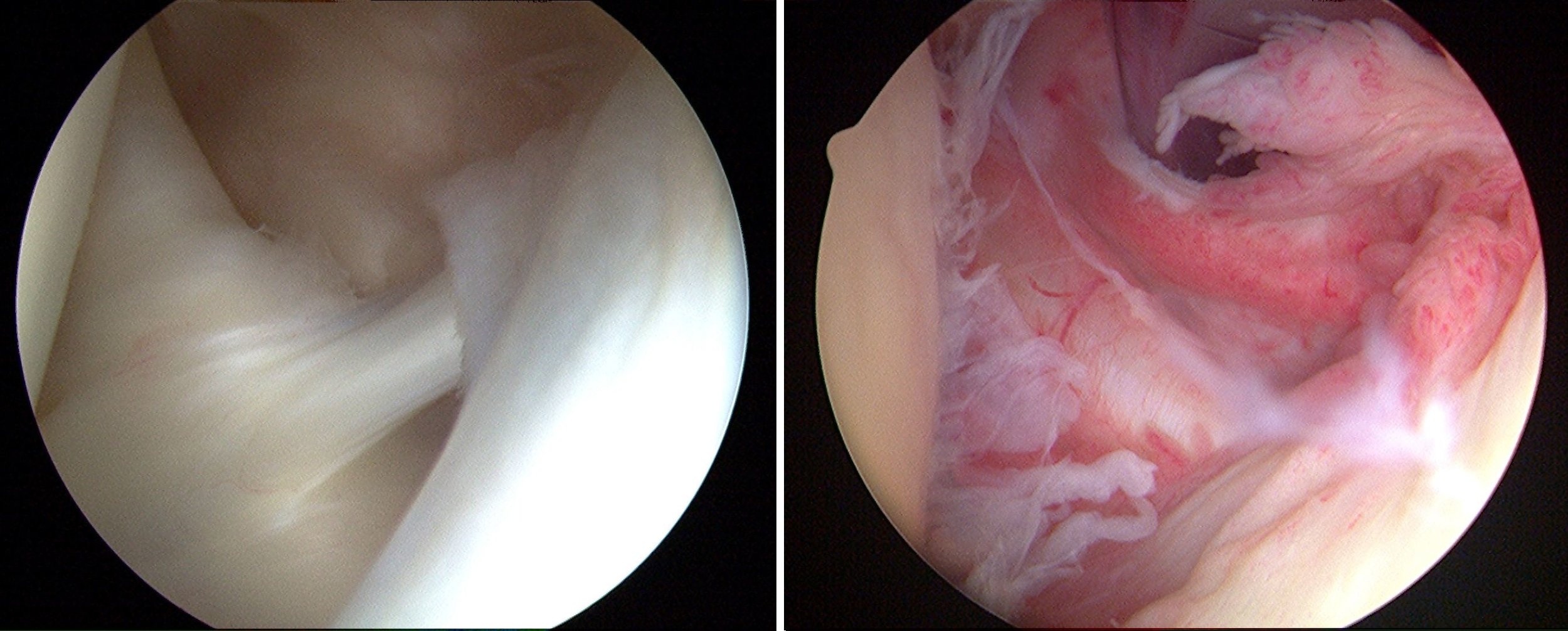
Normal shoulder Inflamed Frozen Shoulder
THE CLINICAL PICTURE
Initially when the shoulder becomes inflamed the pain starts. This may be noticed as a gradual onset of soreness but is often noticed as a distinct pain when the shoulder stretched or pushed. After that the pain gradually becomes worse. It is relatively constant in nature and it is usually worse at night. With time the condition passes through 3 phases.
Freezing Stage:
Initially the pain is present but movement in the shoulder is relatively normal. This is the stage of progressive inflammation with the capsule becoming increasingly inflamed. The shoulder becomes stiffer and more painful. The typical duration is 6 weeks to 9 months.
Frozen Stage:
The inflammation in the shoulder starts to settle so that the shoulder pain starts to improve but the shoulder remains stiff. The duration is usually 4 to 9 months.
Thawing Stage:
With time, the scarring gradually stretches and the full range of motion eventually returns. The usual time course through all three stages is between 9 months and 2 years depending on the severity.
TREATMENT
Initial treatment is focused on treating the pain. Paracetamol and anti-inflammatories such as ibuprofen or diclofenac taken regularly can be effective in managing the pain. Physiotherapy is useful in helping maintaining the movement but can increase the pain during the freezing phase.
CORTISONE INJECTIONS
A corticosteroid injection is a powerful anti-inflammatory medication that can be used to reduce inflammation and pain. For frozen shoulder, an intra-articular steroid injection, where the medication is placed into the shoulder joint, is often preferred.
The injection may reduce pain, improve sleep and help restore movement, particularly when given during the painful early phase. The effect varies between individuals. A steroid injection does not necessarily "cure" the frozen shoulder, but it can provide an important window in which pain is reduced and movement exercises can be performed more effectively.
SURGERY
Arthroscopic capsular release is a keyhole operation used for patients with persistent, severe frozen shoulder that has not responded adequately to non-operative treatment. Small instruments are inserted into the shoulder through several small incisions. The tight and contracted portions of the joint capsule are released under direct vision. The procedure allows careful release the areas restricting movement.
An arthroscopic capsular release may be considered when:
Pain is significant and shoulder movement is severely restricted
Symptoms have persisted despite appropriate non-operative treatment
Frozen shoulder is significantly affecting work, sleep or everyday activities
Bilateral disease