
ACL INJURIES
The anterior cruciate ligament, or ACL, is one of the main stabilising ligaments inside the knee. Tearing it is among the most common serious sporting injuries, and in New Zealand it happens most often on the netball court, the rugby and football field, and the ski slope.
An ACL tear is a significant injury, but it is a well-understood one with a well-established treatment pathway. Most people who want to return to pivoting sport or physically demanding work will be recommended reconstruction, and the great majority do well.
Two things are worth knowing at the outset. A torn ACL does not heal on its own — unlike many ligaments, it does not reliably reattach or scar back together. And it is an injury, so it is covered by ACC, which changes the practical picture considerably compared with a wear-and-tear condition.
What the ACL does
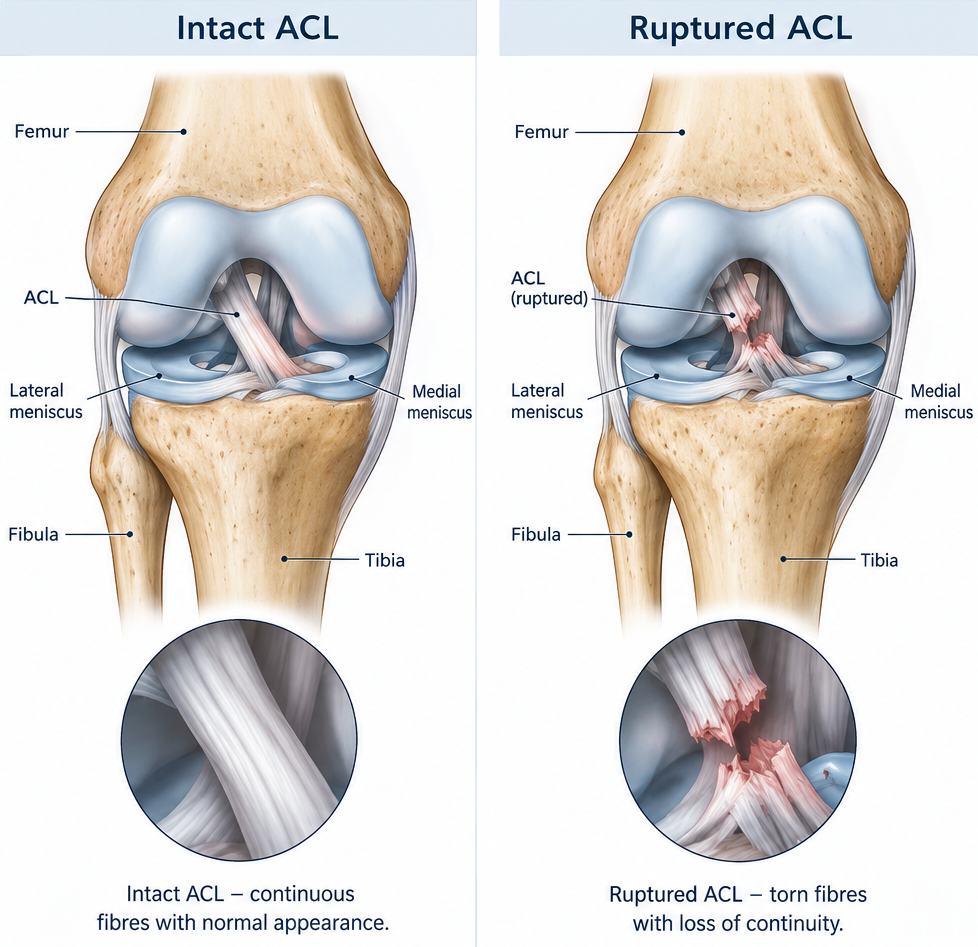
The ACLs role is to stop the shin bone sliding forwards on the thigh bone, and to control rotation. That second role is the one that matters most in practice. The ACL is what allows a knee to plant, turn and change direction under load without the joint shifting. Without it, a knee is often perfectly comfortable walking in a straight line and gives way the moment it is asked to pivot.
The ACL also carries nerve endings that contribute to the knee's sense of its own position, which is part of why balance and control take time to return after an injury.
How the ACL is injured
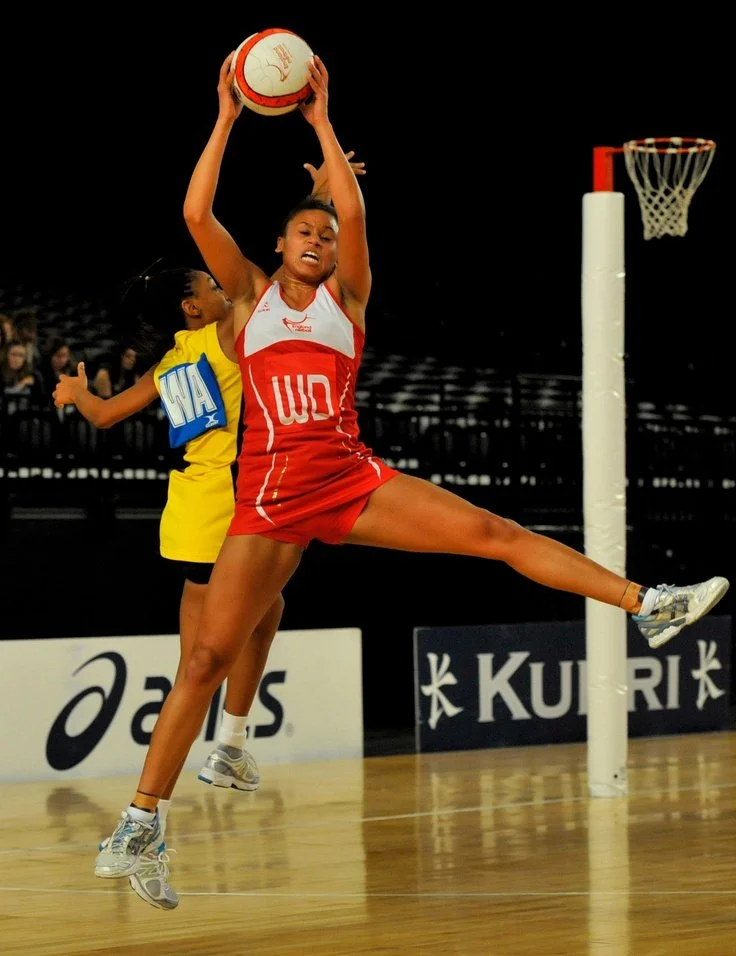
Most ACL injuries are non-contact. The classic mechanism is landing from a jump, decelerating suddenly, or changing direction with the foot planted and the knee rotating inwards. Netball, basketball, football, rugby, and skiing account for the majority in New Zealand. A direct blow to the outside of the knee can also do it, often damaging other structures at the same time.
Certain factors increase the risk. Women are considerably more likely to sustain an ACL injury than men in the same sport, related to differences in anatomy, hormonal factors and landing mechanics. Previous ACL injury, either knee, raises the risk of another. Fatigue and poor landing technique both contribute, and both can be trained.
What it feels like at the time
Most people know something significant has happened.
A pop — heard or felt — is reported by a majority of patients. Immediate pain follows, often with a sense that the knee has shifted or given way. Most people cannot continue playing.
Swelling within a few hours is the most useful single clue. Rapid swelling after a twisting knee injury indicates bleeding inside the joint, and an ACL tear is the most common cause. Swelling that appears the next day is less specific.
In the days afterwards, the knee is often painful, stiff and difficult to straighten fully. As that settles — typically over two to six weeks — many people find the knee feels deceptively normal walking in a straight line. This is the point at which ACL injuries are most often missed. The instability only declares itself when the knee is asked to turn.
Why an ACL tear matters
A torn ACL does not heal. The two ends retract and the ligament loses its blood supply, and although the knee often settles down symptomatically, the stabilising function does not return.
The consequence is episodes of giving way during pivoting or twisting. Each of those episodes is a small injury in itself. Over time, repeated instability damages the menisci and the articular cartilage, and it is this secondary damage — rather than the ACL tear alone — that leads to arthritis developing years later.
This is the central reason reconstruction is recommended for most patients: not simply to allow a return to sport, but to protect the rest of the knee from the cumulative damage that instability causes.
Treatment
Reconstruction
For most patients with a complete ACL tear, reconstruction is the recommended treatment. It is the appropriate path for anyone who wants to return to pivoting sport, who works in a physically demanding or unpredictable environment, who has associated meniscal or ligament injuries requiring treatment, or whose knee is giving way.
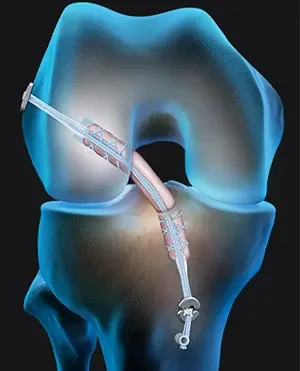
Reconstruction does not repair the torn ligament. The remnants are removed and a new ligament is built from tendon tissue — a graft — passed through tunnels drilled in the thigh and shin bones and fixed in position, reproducing the path of the original ACL. Over the following months the graft develops a blood supply and gradually remodels into a functioning ligament, which is why rehabilitation takes as long as it does.
The results are good. In New Zealand, where every reconstruction is recorded in a national ACL Registry, graft rupture occurs in around 3.5% of patients and around 2.4% require revision surgery. Most patients return to a level of activity they are satisfied with.
When non-operative treatment is appropriate
Not everyone needs surgery. Non-operative management — a structured rehabilitation programme focused on quadriceps and hamstring strength, balance and control — is reasonable for patients who do not participate in pivoting sport, who are older or lower-demand, whose knee is stable in daily life, and who have no meniscal injury requiring treatment.
Some patients manage well this way indefinitely. The approach is only appropriate where the knee is genuinely not giving way, since ongoing instability causes progressive damage. Where a trial of rehabilitation is undertaken and the knee continues to give way, reconstruction remains available.
Timing and preparation
There is usually no rush to operate, and there is real benefit in not rushing.
Operating on a knee that is still swollen, painful and stiff carries a materially higher risk of the knee stiffening up afterwards. The standard approach is a period of prehabilitation first — settling the swelling, regaining full straightening and bending, and rebuilding quadriceps strength — before surgery is scheduled. This typically takes a few weeks.
Prehabilitation is not a delay; it is part of the treatment. The strength and range of movement a patient takes into surgery are among the best predictors of how the recovery goes, and a knee that goes in quiet and strong comes out better.
The main reason to operate sooner is a locked knee caused by a displaced meniscal tear, which needs earlier attention.
Graft choice
The new ligament is usually made from the patient's own tissue. There are two main graft choices in common use, each with a different profile. The registry evidence shows modest but real differences.
Patellar tendon grafts have a lower re-rupture rate than hamstring grafts, and are often preferred for young athletes returning to high-level pivoting sport. The trade-off is a higher rate of pain at the front of the knee and discomfort kneeling, which matters a great deal to some occupations and not at all to others.
There is no single best graft. The choice is made with the patient, based on age, sport, occupation, kneeling demands and previous surgery.
The operation
ACL reconstruction is performed arthroscopically under general anaesthetic, usually as day surgery. It typically takes about one hour.
The graft is harvested through a separate incision and prepared. The remnants of the torn ACL are removed, and tunnels are drilled in the thigh and shin bones at the precise points where the original ligament attached. The graft is passed through these tunnels and fixed, usually with small screws or suspensory devices. Accurate tunnel placement is the single most important technical factor in the outcome.
Any associated injuries are dealt with at the same time. Meniscal tears are repaired where possible — preserving the meniscus matters for the long-term health of the knee — or trimmed where repair is not feasible. In selected high-risk patients, an additional procedure on the outer side of the knee may be added to further control rotation.
Rehabilitation and recovery
Rehabilitation after ACL reconstruction is long, structured and central to the outcome. The surgery creates the opportunity; the rehabilitation determines the result. Patients who commit to it do markedly better.
Progression is guided by achieving specific goals rather than by the calendar alone. The timeframes below are typical.
Initially, the focus is settling pain and swelling, restoring full movement — particularly full straightening — and reactivating the quadriceps, which switches off remarkably quickly after knee surgery.
Crutches are used initially, usually for up to one week, and a brace may be used depending on what else was done. Weight can generally be put through the leg early. Driving typically becomes possible at around two weeks for a left knee in an automatic, and around four to six weeks for a right knee, once control is confident.
Desk-based work is often possible within one week. Physical work takes considerably longer. If light duties are available, these can commence after four to six weeks. Heavy, physical work is around three months.
Strength is the focus once good movement is achieved. Progressive resistance work builds the quadriceps, hamstrings, calf and hip muscles. Straight-line running usually begins somewhere around the four month mark, once strength and control benchmarks are met — not simply once four months have passed.
Cycling, swimming and gym work are well established by this stage.
The final stage of recovery is sport-specific work: agility, cutting, pivoting, landing mechanics and, finally, contact and competition. This phase is where re-injury risk is managed, and it is the phase most often cut short.
Return to pivoting sport is generally not before nine to twelve months, and should be based on meeting objective criteria — strength testing, hop testing, movement quality and psychological readiness — rather than on the date. The evidence is clear that returning early, and returning without meeting strength benchmarks, substantially increases the risk of a further rupture.
Full recovery of strength and confidence often continues into the second year.
Return to sport — what the evidence shows
Most patients return to sport, but not all return to the same level. Across the published evidence, roughly two-thirds of patients return to their pre-injury level of activity, and around half to competitive sport. Rates are higher in younger athletes and in those who complete a full criteria-based rehabilitation programme.
The reasons for not returning are as often psychological as physical — fear of re-injury is one of the most common — which is why confidence and movement quality are part of the rehabilitation rather than an afterthought.
Re-injury risk is real and highest in the young. New Zealand registry data shows patients under 18 have several times the revision rate of patients over 36. Returning to sport before nine months, and returning without meeting strength criteria, both increase that risk substantially. The risk of injuring the other ACL is also elevated.
None of this argues against reconstruction — it argues for completing the rehabilitation properly and returning when ready rather than when eligible.
Reducing the risk of another injury
Structured neuromuscular training programmes — landing technique, balance, hamstring strength and agility drills — have been shown to substantially reduce ACL injury rates in sport, particularly in women. Most sporting codes now have a version, and many are freely available in New Zealand.
These are worth doing both as prevention before any injury and as part of the return-to-sport phase afterwards. For a patient who has torn one ACL, protecting the other knee is a genuine consideration.
Risks and complications
ACL reconstruction is a safe, well-established operation and serious complications are uncommon.
Pain at the front of the knee occurs in around 10 to 20% of patients, more commonly after a patellar tendon graft, and can make kneeling uncomfortable.
Loss of movement or stiffness affects fewer than 5%, and is most likely where surgery was performed on a knee that was still swollen and stiff — the reason prehabilitation matters.
Infection is uncommon, occurring in roughly 0.2 to 0.5% of cases.
Graft rupture, in around 3.5% of patients in New Zealand registry data, and considerably higher in young athletes returning to pivoting sport.
Blood clots in the leg or lung, which are uncommon but recognised.
Numbness around the incisions, which is common and usually of no consequence.
Later arthritis. Reconstruction reduces instability and protects the knee from further damage, but it does not eliminate the increased long-term risk of arthritis that follows a significant knee injury. This is worth knowing rather than worrying about — it is a reason to maintain strength and a healthy weight over the following decades.
ACC and costs
An ACL injury is an accident, so treatment is generally covered by ACC, including specialist assessment, MRI, surgery and post-operative physiotherapy.
In practice this means an ACC claim is lodged — usually by whoever first sees the injury, whether a GP, physiotherapist or emergency department — and surgery is approved on the basis of the clinical assessment and imaging.
The practice can help with the ACC process and will explain what is covered and what, if anything, is not before any surgery is arranged.