
SHOULDER REPLACEMENT
Shoulder arthritis is wear of the smooth cartilage lining the shoulder joint. As that lining thins, the bones begin to rub against one another, and the shoulder becomes painful and progressively stiffer. It develops slowly over years rather than appearing suddenly.
It is less common than arthritis of the hip or knee, largely because the shoulder is not weight-bearing. That also means it is often tolerated for a long time before people seek help — many patients have quietly adjusted their lives around a shoulder that no longer moves properly, and only come forward when sleep becomes disturbed or a task they value becomes impossible.
The important thing to know at the outset is that most people with shoulder arthritis are managed successfully without surgery, often for many years.
Understanding the shoulder joint
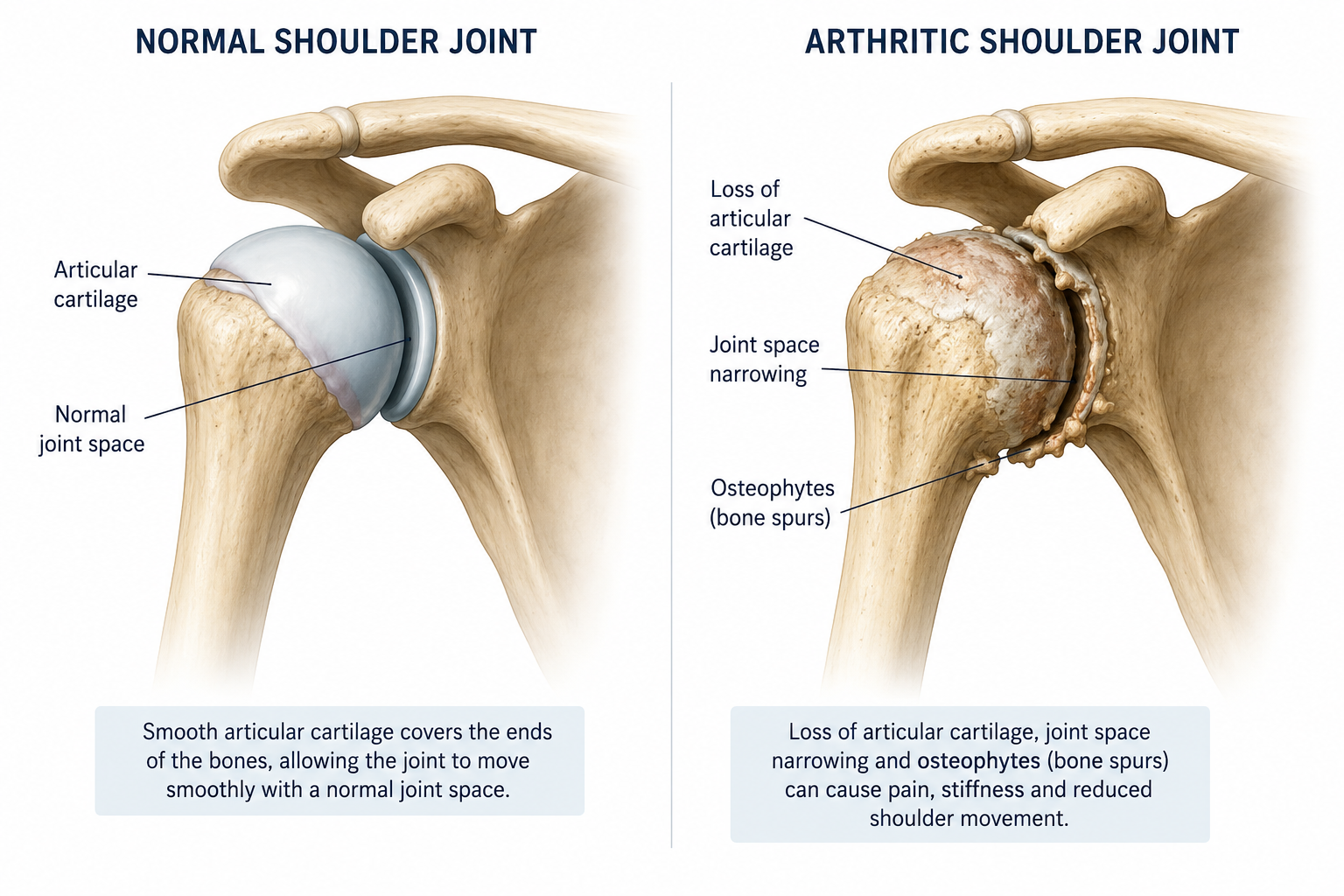
The shoulder is a ball-and-socket joint. The ball is the head of the humerus, the upper arm bone. The socket, called the glenoid, is a shallow dish on the outer edge of the shoulder blade. Both surfaces are coated in articular cartilage — a firm, slippery layer a few millimetres thick that allows the joint to glide with almost no friction.
Arthritis of the ball-and-socket joint is called glenohumeral osteoarthritis. As the cartilage wears, three things happen together. The joint surfaces roughen and the space between them narrows. Bone spurs, called osteophytes, form around the rim of the humeral head. And the capsule surrounding the joint thickens and tightens — which is why stiffness, as much as pain, is such a prominent feature of the condition.
What causes shoulder arthritis?
In most cases there is no single cause. Age is the strongest factor — arthritis becomes considerably more common beyond the age of 60 — but several other influences are recognised.
Genetics. A family history of osteoarthritis meaningfully increases risk. Some people simply have cartilage that wears earlier, and this is not something that can be changed.
Previous injury. Arthritis that follows an injury is called post-traumatic arthritis. Fractures involving the joint surface, and repeated shoulder dislocations, are the common precursors. This form can appear decades after the original event and often affects younger patients.
Previous shoulder surgery. Some older stabilisation procedures for recurrent dislocation are associated with arthritis developing years later.
Rotator cuff problems. When the rotator cuff is torn and no longer holds the ball centred in the socket, the joint wears in an abnormal pattern. This is a distinct condition with its own treatment considerations.
Heavy repetitive loading. Occupations and sports involving sustained overhead or heavy work may contribute, though the evidence here is less clear-cut than for the hip and knee.
Contrary to a common assumption, shoulder arthritis is not caused by "using the shoulder too much" in any ordinary sense, and there is usually nothing a patient did to bring it on. Nor does continuing to use an arthritic shoulder sensibly cause further damage — inactivity does more harm than careful activity.
What to expect over time
Osteoarthritis is generally progressive, but the rate varies enormously between individuals and cannot be predicted from a first X-ray. Some shoulders change very little over a decade. Symptoms also fluctuate — most patients experience flares lasting weeks to months, separated by quieter periods, and a bad spell does not mean permanent deterioration.
There is no evidence that delaying surgery in a well-managed shoulder leads to a worse eventual result. This means there is no pressure to make decisions quickly, and non-operative treatment can be pursued properly and for as long as it continues to work.
Non-surgical treatment
The goals of non-operative management are to control pain, preserve and where possible improve movement, keep the surrounding muscles strong, and maintain independence in the activities that matter to each patient. These are achievable goals for the great majority of people.
No treatment currently available regrows cartilage or reverses the underlying arthritis. What follows is aimed at symptoms and function — which, in practice, is what determines quality of life.
Exercise and physiotherapy
Exercise is the foundation of non-operative treatment and, for most patients, the single most useful thing they can do. A well-conditioned shoulder tolerates an arthritic joint considerably better than a deconditioned one, and regular movement limits the capsular tightening that drives progressive stiffness.
A programme for shoulder arthritis usually has three parts:
Range of movement work. Gentle, sustained stretching into the directions that have been lost — particularly external rotation and reaching behind the back. Pendulum exercises, assisted stretches using the other arm or a stick, and doorway or wall stretches are typical. These are done little and often, ideally daily.
Scapular and postural strengthening. The shoulder blade provides the platform the arm works from, and improving its control frequently reduces shoulder pain even though the arthritic joint itself is unchanged. This work is usually well tolerated because it does not load the painful joint directly.
Rotator cuff strengthening. Low-load, controlled strengthening using resistance bands, generally kept below shoulder height and close to the body to avoid provoking pain.
Two things are worth being clear about. First, some discomfort during and shortly after exercise is expected and acceptable — pain that settles within an hour or so is not a sign of harm. Pain that is sharply worse and persists into the following day suggests the load was too high, and the programme should be eased rather than abandoned.
Second, this takes time. Meaningful improvement typically takes six to twelve weeks of consistent work, and the benefit is lost if the programme stops. Consistency matters far more than intensity. Most patients do best with a short initial period of physiotherapy guidance to establish the right exercises and technique, followed by an independent home programme that continues indefinitely.
Swimming, hydrotherapy and gentle cycling are all well suited to arthritic shoulders and can be continued long term.
Activity modification
Adjusting how the shoulder is used, rather than using it less, is often the change that makes the biggest practical difference.
The general principle is to keep loads close to the body and below shoulder height. Lifting a weight with the arm extended away from the body multiplies the force through the joint several times over; the same weight held close is far better tolerated. Practical adaptations include moving frequently used items from high shelves down to waist level, using a step rather than reaching up, carrying shopping in two lighter loads rather than one heavy one, using a trolley or wheeled bag, and switching to lighter tools or long-handled equipment for garden work.
Repetitive overhead activity — painting a ceiling, prolonged work above head height — is the classic provoker and is best broken into shorter blocks with rests.
Managing night pain
Disturbed sleep is often the symptom patients find hardest, and it responds well to some simple measures. Sleeping propped slightly upright, either on extra pillows or in a recliner, is frequently effective. Placing a pillow under the affected arm to support it and prevent it dropping backwards relieves tension on the joint. Avoiding lying directly on the affected side is often necessary. Heat applied to the shoulder before bed, and taking regular pain relief timed to cover the night rather than only when pain wakes them, both help.
Simple pain relief
Paracetamol taken regularly — rather than only when pain is bad — is a reasonable first step and is well tolerated by most people. The usual maximum is 4 grams in 24 hours for adults, and lower in some circumstances.
Anti-inflammatory medications (NSAIDs) are often more effective, particularly during a flare. They carry gastrointestinal, kidney and cardiovascular risks, and are best used at the lowest effective dose for short periods rather than continuously. Anyone with existing heart, kidney, blood pressure or stomach problems, or taking other regular medications, should discuss them with their GP or pharmacist before starting.
Topical anti-inflammatory gels applied over the shoulder are a useful option with far less systemic absorption than tablets, and are worth trying before oral anti-inflammatories in patients where tablets are a concern.
Stronger pain medications such as opioids have no useful role in the long-term management of shoulder arthritis and are not recommended.
Corticosteroid injection
An injection of corticosteroid, usually combined with local anaesthetic, into the shoulder joint can settle a painful flare. It is most useful when pain is severe enough to prevent someone doing their exercises — the injection creates a window in which rehabilitation becomes possible, and the two work best together.
Repeated injections are generally avoided. There is no fixed limit, but frequent injections into the same joint offer diminishing returns, and it is reasonable to reconsider the overall plan if a shoulder is needing them regularly.
Supplements
Glucosamine, chondroitin and fish oil are frequently asked about. There is some evidence supporting them in shoulder arthritis however it is weak. They are, however, safe for most people to trial, and some patients report benefit. If there is no clear improvement after two to three months, there is little reason to continue.
General health
Two general measures are worth mentioning. Maintaining a healthy weight reduces systemic inflammation and improves outcomes in osteoarthritis generally, even in a non-weight-bearing joint. Not smoking matters for cartilage and bone health, and becomes particularly important should surgery ever be needed.
Aids and adaptations
Occupational therapy input can be valuable for patients whose arthritis is limiting daily tasks. Long-handled reachers, shower and dressing aids, jar openers, lightweight cookware and adjustments to the workplace or car can all preserve independence without any medical intervention at all.
What treatments are not recommended
It is worth being explicit about a few things patients commonly encounter:
Arthroscopic (keyhole) surgery has a very limited role in established shoulder arthritis. It does not treat the underlying problem, and any benefit is usually short-lived. It may occasionally be considered in selected younger patients with early changes or loose fragments.
Prolonged rest or immobilisation in a sling worsens stiffness and weakness and should be avoided outside of an acute flare.
Manipulation of a stiff arthritic shoulder is not appropriate, unlike in some cases of frozen shoulder.
Repeated frequent corticosteroid injections as an ongoing strategy, as above.
When surgery is considered
Shoulder replacement is the treatment of choice for glenohumeral arthritis. Non-operative treatment is continued for as long as it is working, and for some people that is indefinitely. Surgery becomes a reasonable discussion when three things are true together: pain and stiffness are significantly limiting daily life or sleep, a genuine trial of the measures above has not given adequate benefit, and the patient themselves wants an operation.
Age alone is not a barrier in either direction, and there is no need to rush. If that point is reached, shoulder replacement is a reliable operation for relieving pain and improving function.