
KNEE REPLACEMENT
A knee replacement removes the worn surfaces of an arthritic knee and replaces them with smooth artificial components. It is among the most successful operations in modern medicine, and for someone whose life has narrowed around a painful knee, it is often transformative.
It is also a bigger undertaking than many people expect. The operation itself is routine; the recovery takes real work, and the first six weeks are demanding. Patients who go in understanding that consistently do better than those who don't, which is why this page is as detailed about the recovery as it is about the surgery.
Not every arthritic knee needs the whole joint replaced. Where wear is confined to one part of the knee, a partial replacement may be possible — a smaller operation with a quicker recovery. Both are covered below.
What the operation replaces
The knee is made up of three compartments: the medial compartment on the inner side, the lateral compartment on the outer side, and the patellofemoral compartment where the kneecap runs in its groove at the front. All three are lined with articular cartilage, a smooth layer that lets the joint move almost without friction.
In knee arthritis that cartilage wears away, leaving bone rubbing on bone. The knee becomes painful and stiff, bone spurs form, and the leg often begins to bow inwards or outwards as one side of the joint wears down faster than the other.
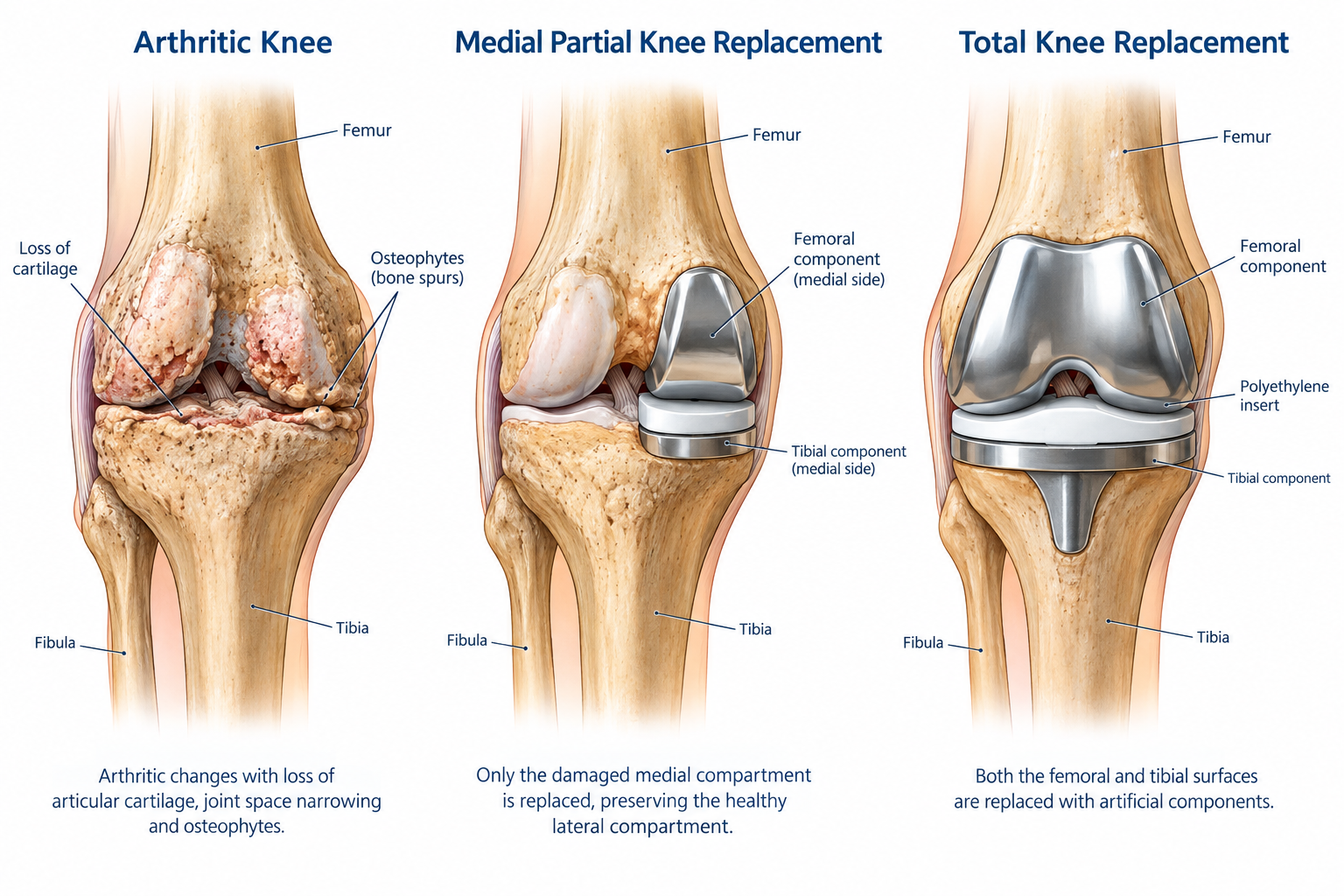
A knee replacement is really a resurfacing. The worn few millimetres are removed from the end of the thigh bone and the top of the shin bone, and replaced with metal components shaped to reproduce the joint's contours. A durable plastic (polyethylene) bearing sits between them and takes the place of the cartilage. The back of the kneecap may also be resurfaced. The ligaments that stabilise the knee are preserved wherever possible, and it is these that make the joint feel like a knee rather than a hinge.
Total or partial replacement
A total knee replacement resurfaces the whole joint. It is the right operation for most patients, and it is appropriate whatever the pattern of wear.
A partial knee replacement — also called a unicompartmental replacement — resurfaces only the worn compartment and leaves the rest of the knee, including the cruciate ligaments, untouched. The great majority are performed on the medial (inner) side.
The trade-off is genuine and worth understanding. A partial replacement recovers faster and tends to feel more like a normal knee, because the ligaments and the other two compartments are left alone. But it is revised more often over time — in New Zealand registry data, roughly two times as often as a total replacement — partly because arthritis can later develop in the compartments that were left, and partly because it is generally offered to younger, more active patients. Converting a partial to a total replacement later is a well-established operation with a good result.
Suitability is decided on the X-rays, the pattern and location of pain, whether the cruciate ligaments are intact, the alignment of the leg and whether the deformity corrects, and the range of movement. Only a minority of arthritic knees qualify — in New Zealand, partial replacements make up around a tenth of knee replacements performed.
Who a knee replacement suits
Knee replacement is considered when three things are true together: pain and stiffness significantly limit daily life or sleep, non-operative treatment has been tried without adequate benefit, and the patient themselves wants an operation.
Non-operative treatment means a genuine trial of the measures covered on knee arthritis page — exercise and strengthening, weight management where relevant, activity modification, appropriate pain relief and, where indicated, injection. Surgery is not a substitute for having done that work, and patients who arrive at surgery with stronger legs recover faster.
Age is not in itself a barrier. Younger patients are candidates, but implants have a finite life and a replacement performed at 55 is more likely to need revision during a lifetime than one performed at 75. That is a factor to weigh rather than a reason to refuse.
There is no advantage in waiting until a knee is unbearable. Very stiff knees and very deformed legs are harder to correct and tend to end up with less movement afterwards. Equally, there is no need to rush — delaying a well-managed knee does not usually compromise the eventual result.
Getting ready
Preparation makes a measurable difference to recovery, and there is usually time to do it properly.
Prehabilitation. Strengthening the quadriceps and hamstrings in the weeks before surgery genuinely speeds recovery. A knee that goes into surgery strong comes out of it stronger. A physiotherapist can set a programme; cycling, pool work and simple straight-leg exercises are all useful.
Weight. Where weight loss is achievable it reduces surgical risk, particularly of infection, and reduces load on the new joint. This is raised as a practical matter, not a judgement.
Stopping smoking, even for a few weeks beforehand, meaningfully reduces the risk of infection and wound problems.
Dental and skin health. Any dental problems are best dealt with before surgery, and any skin breaks, ulcers or infections on the leg should be reported, as surgery may need to be deferred.
Home preparation. Clear trip hazards and loose rugs, arrange a firm chair with arms, put frequently used items within reach, consider a raised toilet seat and a shower stool, prepare and freeze some meals, and arrange help at home for the first week or two. Transport will be needed, as driving is not possible initially. Patients who live alone, or whose home has stairs to the front door, should raise it at the consultation so it can be planned for.
The operation
Knee replacement is performed under general or spinal anaesthetic, often with a nerve block or local anaesthetic infiltration for pain relief afterwards. Antibiotics are given to reduce the risk of infection. The operation usually takes around two hours.
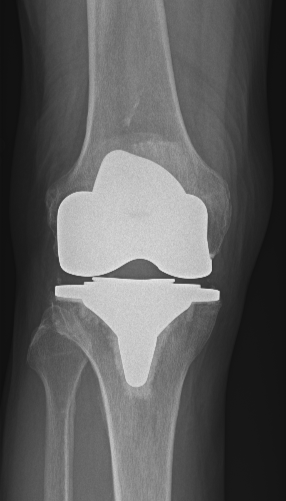
An incision is made over the front of the knee. The worn surfaces at the end of the thigh bone and the top of the shin bone are removed and precisely reshaped so the components sit accurately and the leg is correctly aligned. The components are fixed to the bone, usually with cement, and the plastic bearing inserted between them. The back of the kneecap may be resurfaced. Throughout, the balance of the ligaments and the movement of the knee are checked carefully — getting this right is what determines how the knee feels afterwards, as much as the implants themselves.
A partial replacement follows the same principles through a smaller incision, resurfacing only the affected compartment.
In hospital
Most patients stay around two days in hospital. Standing and walking begin the day of surgery, with a physiotherapist and a walking frame or crutches. Weight can be put through the leg straight away. This early start is deliberate — it reduces the risk of clots and stiffness and speeds recovery.
Pain is managed with a combination of regular medication, the nerve block or local anaesthetic given during surgery, and ice. The knee will be swollen and sore, and this is expected.
Before discharge, patients need to be walking safely with crutches or a frame, managing stairs if there are stairs at home, and confident with the exercise programme. Blood-thinning medication is usually prescribed for a period afterwards to reduce the risk of clots.
Recovery
Knee replacement recovery is longer and more demanding than most patients expect, and it is worth being direct about that. It is also predictable, and almost everyone gets there.
The first two weeks is the hardest period. The knee is swollen, sore and stiff, and sleep is often disturbed. Crutches or a frame are used for walking. Pain relief is taken regularly rather than waiting for pain, and ice and elevation are used several times a day.
Exercises begin immediately and are done several times daily. Two things matter above all: getting the knee fully straight, and bending it progressively. Of these, straightening is the more important and the more easily lost — a knee that does not fully straighten in the early weeks can be difficult to correct later, and it affects walking permanently. Sleeping or resting with a pillow under the knee feels comfortable and is one of the more common causes of this problem, so it is avoided; a pillow under the ankle, letting the knee straighten, is better.
Driving typically becomes possible at around six weeks, once off crutches and able to perform an emergency stop comfortably. For a left knee with an automatic car it may be earlier. Check the position with your insurer.
The result is usually judged at around twelve months, and many patients notice continued small gains into the second year. Patients who feel their progress has stalled at three or four months are usually still on a normal trajectory.
Physiotherapy is essential rather than optional. The eventual result depends significantly on the work done in the first three months.
What to expect afterwards
Being clear about this matters. Knee replacement has slightly lower satisfaction rates than hip replacement, and the difference is largely about expectations rather than surgical quality — a knee is a more complex joint, and it feels more like an implant afterwards than a hip does.
Pain relief is the main benefit and it is reliable. The great majority of patients get substantial, lasting relief from the arthritic pain, and this is what most say has changed their life.
Movement is usually good but not normal. Most patients achieve enough bend for stairs, cars, cycling and normal activity. Very deep bending — squatting fully, sitting back on the heels — is often not regained. Patients who were very stiff beforehand end up with less movement than those who were not.
Kneeling is often uncomfortable, sometimes permanently. The knee is generally safe to kneel on; it simply doesn't feel pleasant. Patients whose work or faith practice requires kneeling should raise this before surgery.
The knee will feel different. A patch of permanent numbness on the outer side of the scar is normal and results from small skin nerves divided during the approach. Clicking sounds from the implant are normal. Warmth and swelling after activity persist for many months. Many patients remain aware of the knee as an artificial joint — this is normal and not a sign of a problem.
Around 8 to 9 out of 10 patients report being satisfied, with pain relief the strongest driver. Where patients are less satisfied, it is most often because expectations were higher than what the operation can deliver, which is why this section is written as plainly as it is.
Activities and restrictions
A knee replacement suits walking, tramping on reasonable ground, golf, swimming, cycling, bowls, doubles tennis, gardening, dancing and gym work on machines.
It is not suited to running as regular exercise, jumping sports, singles tennis, skiing at pace, or heavy repetitive squatting and kneeling. These accelerate wear of the plastic bearing and increase the risk of loosening.
Results and how long it lasts
New Zealand has a national joint registry that has recorded every joint replacement performed in the country since 1999, giving unusually reliable long-term data. Knee replacement is the most common joint replacement performed here, with close to ten thousand carried out each year.
Total knee replacement performs extremely well. The registry records a revision-free survival of over 90% at twenty years.
Partial knee replacement has a higher revision rate, with about three-quarters still in place at twenty years. As above, this reflects both the younger patients who receive them and the possibility of arthritis developing in the remaining compartments.
Revision rates are higher in younger patients and in those with a BMI over 40, both of which are worth factoring into the timing of surgery.
Risks and complications
Knee replacement is a safe and well-established operation, and serious complications are uncommon. They are worth understanding before deciding, and Mr Coleman will discuss them in the context of each patient's own health.
Infection occurs in approximately 1% of cases. Superficial infection may settle with antibiotics; deep infection around the implant is uncommon but usually requires further surgery.
Blood clots in the leg or lung. Preventive measures — early mobilisation, blood-thinning medication and compression — substantially reduce this risk, but it is not eliminated.
Persisting pain. A minority of patients continue to have pain in the knee despite a technically satisfactory replacement. This is the most common reason for dissatisfaction and is not always explicable.
Stiffness, sometimes requiring manipulation under anaesthetic to improve movement. Most common in patients who were stiff beforehand or who struggle with early rehabilitation.
Loosening or wear of the components over time, which is the usual long-term reason for revision surgery.
Numbness around the scar, which is very common and usually permanent, though rarely troublesome.
Nerve or blood vessel injury, which is rare.
Fracture of the bone around the implant, either during surgery or from a later fall.
Ongoing swelling, warmth or clicking, which are usually normal rather than complications, but are worth having checked if they concern you.